Stickman Bridge Constructor is easiest to master when you build for perfect balance using three repeatable principles: a clear load path from deck to anchors, triangle-based bracing to stop deformation, and controlled flex that survives stress tests. Drawing on practical bridge-building logic and hands-on gameplay patterns our team at ComicK has seen across physics construction games, these fundamentals consistently turn fragile designs into stable clears.
Next, you will learn the 3 ultimate secrets step by step, with quick fixes for common collapse points so you can build stronger bridges immediately.
Before the secrets, define the target. A “balanced” bridge in Stickman Bridge Constructor usually has:
When you build with those outcomes in mind, the game stops feeling like guesswork.
Most failed bridges are missing one thing: a deliberate path for force to travel. If the deck has nowhere solid to “send” the load, the game will punish you with bending, snapping, and sudden collapse.
A strong bridge begins at the attachment points. Your first question should be:
Even in a simplified physics game, this mental model matters.
A reliable approach:
The highest stress usually concentrates at:
In those zones, long pieces behave like levers, amplifying forces and making failures dramatic.
A practical rule:
After a basic build, run a test and watch one thing:
If yes, your load path is not continuous. Fix it by connecting that hinge into the rest of the structure with a direct support line (or by converting the shape into triangles, which leads into Secret 2).
If you remember only one structural principle for Stickman Bridge Constructor, make it this:
This is the secret behind nearly every “suddenly unbreakable” bridge.
A truss is just a repeating series of triangles. In game terms, it means your bridge stops behaving like a bending plank and starts behaving like a stable framework.
High-percentage patterns:
When you build, scan for rectangles and fix them:
Stickman Bridge Constructor physics often punishes imbalance. Even a small asymmetry can create rotation or twisting that compounds over time.
Use symmetry to reduce chaos:
You can still solve odd layouts, but symmetry should be your default until the level forces creativity.
Many players spam beams but ignore joints. Joints are where the bridge fails, especially when the stickman’s movement causes micro-bounces.
To strengthen a joint:
If your bridge “almost works” but snaps at one spot, that is almost always a joint problem.
Players often chase “perfectly rigid” bridges. In physics puzzle games, that can backfire. The better goal is:
A bridge that flexes slightly and returns to form is often more stable than a bridge that is rigid but brittle.
Most bridges flex at mid-span. That is normal. What you must avoid is uncontrolled hinging, where the structure folds like a door.
A balanced flex zone looks like:
How to create it:
If you rebuild the entire bridge every attempt, you never learn what fixed the problem.
A reliable iteration loop:
This is how you move from “random builds” to repeatable wins.
Bridges often survive the first steps and fail later. The most dangerous moments are:
So your stress test mindset should be:
If you want a practical template for most levels, use this sequence:
This blueprint matches the three secrets: load path first, triangles everywhere, controlled flex with testing.
Likely cause: a rectangle span or a long unsupported deck.
Fast fixes:
Likely cause: asymmetry or uneven joint stress.
Fast fixes:
Likely cause: lever effect from long members or too much force at a single joint.
Fast fixes:
Likely cause: overbuilding instead of targeted reinforcement.
Fast fixes:
A single load path is efficient but fragile. Tough levels reward redundancy.
You do not need double everything. You need a smart safety net.
Slope transitions create sudden force spikes. Build a reinforced “transition zone”:
If you optimize too early, you remove the exact margin that kept you alive.
A simple policy:
That order produces consistent progress.
Geometry Dash trains the same core skill you need in Stickman Bridge Constructor: tight execution with zero tolerance for sloppy decisions. In Geometry Dash, one mistimed jump ends the run; here, one poorly braced joint ends the bridge. If you apply that same discipline, build symmetrically, brace every rectangle into triangles, and test one change at a time, your “perfect balance” solutions become faster to find and far more consistent.
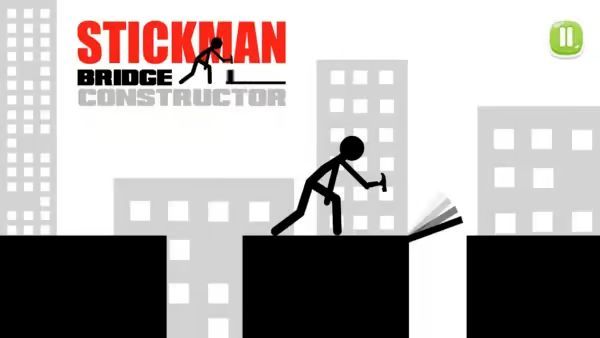
Stickman Bridge Constructor is a physics-based bridge building puzzle game where you design structures that carry a stickman safely across gaps.
It means the bridge carries the load smoothly with minimal twisting, no sudden hinge folding, and enough stability to survive mid-span stress.
Build a clear load path from deck to anchors, then convert flat spans into triangles with diagonal braces.
Anchor areas concentrate stress. Long members act like levers and overload the joint. Use short pieces and A-frame triangles near anchors.
Triangles resist shape change under load. They prevent rectangles from deforming into diamonds, which is the core cause of sag and collapse.
Under-deck trusses are usually the simplest and most stable for most gaps. Top trusses can work well when the level layout favors them, but they still need triangle bracing.
Twisting is often caused by asymmetry or uneven joint reinforcement. Mirror the structure and add cross-bracing to resist lateral movement.
Not always. Controlled flex is often more stable than brittle rigidity. Aim for small, even sag without sharp hinge points.
Watch where the failure starts, not where it ends. Reinforce the first joint that bends sharply or begins the twist.
Once the bridge clears reliably, remove one piece at a time and retest. Keep pieces that form triangles in your load path and remove decorative supports.
The most reliable way to achieve “perfect balance” in Stickman Bridge Constructor is not brute force building. It is applying three repeatable principles: build the load path first, stabilize everything with triangles, and allow controlled flex while stress-testing methodically. When you play with those secrets, your bridges stop collapsing “randomly” and start behaving like structures you can predict, refine, and clear with confidence in Stickman Bridge Constructor.